
Becoming a Bar Mitzvah

Celebrate with us
10•10•2026
We are so honored to have you join us in celebrating this significant milestone! We can't wait to welcome you and to watch as Ari is called to the Torah as a bar mitzvah.
Aryeh /
אריה

The Celebration
A day of reflection, joy, and community celebration!
09:30 AM
October 10th 2026

Temple Emunah Service
Temple Emunah
9 Piper Rd
Lexington, MA 02421
jodie.parmer@gmail.com
Kiddush luncheon to follow
06:00 to 10:00 PM
Party on!
City Point Brewery
200 5th Avenue
Waltham, MA 02451
Dinner will be served.
Party attire
Temple Emunah
Temple Emunah, 9 Piper Rd, Lexington, MA 02421
City Point Brewery
City Point Brewery, 200 5th Avenue, Waltham, MA 02451
Where to stay
NOTE: Guests should check the hotel websites for current rates as they may be cheaper than the reserved rates!
We have reserved a limited number of rooms at the Westin hotel located in Waltham, Massachusetts, near the synagogue and the party venue. Rooms are available on a first-come, first-served basis. Book by September 10, 2026 for reserved rates.
Guests will need to arrange their own transportation (either a car rental or an uber/taxi) to and from the hotel and synagogue. The party venue is located within walking distance to the Westin hotel.
Guests may choose to book alternative hotels that are closer to the city or other Boston-area attractions. Please be sure to check the distance to/from the synagogue and party venue prior to booking as public transportation is not a viable option.

Located just minutes from Temple Emunah and a short walk to the party venue.
Room block reserved for $179 to $209/night
Book by September 10 for room block rates
The Westin Waltham Boston
70 Third Avenue
Waltham, MA 02451, US
(781) 290-5600

Note: There is no room block for this hotel
Fairfield Inn & Suites Boston Waltham
250 Second Avenue
Waltham, Massachusetts 02451
(781) 202-5150
Shabbat Services
A guide for the perplexed
Whether you've never stepped foot inside a Jewish synagogue or it's been a few years, we want you to feel comfortable and have an understanding of the customs and observances. Use the guide below for all the need-to-know information and what to expect. Still have questions, just ask!

Rules and Customs
There are as many ways to be Jewish as there are Jews and this rich diversity makes for a beautiful tapestry of the Jewish people. Still, many communities have certain rules and customs that should be observed by all -- members and guests alike. To help you feel comfortable and be respectful of our community's observances, we've outlined some of these customs.
Temple Emunah is a member of the United Synagogue of Conservative Judaism and welcomes the participation of people of all abilities, backgrounds, sexual orientations and gender identities.
1. The use of electronics of any kind is strictly forbidden on Shabbat and phones/devices should be turned on silent (not vibrate). This includes cell phones, smartwatches, tablets, etc. If you are medical professional who is on call, please keep your phone or pager on vibrate or silent.
2. Photography of any kind (digital, analogue or phone) is prohibited. We understand the desire to capture certain moments, but rest assured, there will be opportunities to do so at the appropriate time.
3. Wearing a kippah (yarmulke or skullcap). Temple Emunah encourages all male-identified individuals to cover their head when they are inside the building as a sign of respect. Female-identified individuals may also choose to wear a kippah, but it is not a requirement. Kippot and other head coverings will be provided for anyone who does not have their own (the kippah is a keepsake!).
NOTE: A tallit (fringed prayer shawl) should NOT be worn unless you are a Jewish adult and you choose to wear one.
4. The Shabbat morning service (shacharit) consists of several parts (described in detail below) and is about 3-hours long. Services begin around 9:30 AM and conclude around 12:30 PM. It is customary to be present for the whole service, however, you are welcome to leave the main sanctuary for whatever reason if the need arises. If you need to excuse yourself, try to do so quietly, but please remember that electronic devices should not be used even in areas outside of the main sanctuary.
A Visual Guide

.avif)



What to Expect
What time should I show up?
Morning services begin at about 9:30 AM.
What should I wear?
Nice clothes such as a collared, button down shirt and slacks for men (tie optional), and dress, skirt, or pants and blouse for women.
I don't read Hebrew––will I be able to follow along?
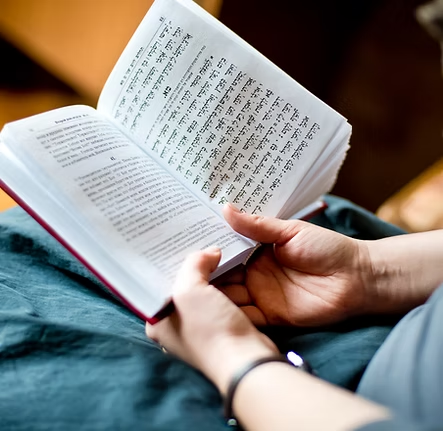
Yes! The prayer leader will announce the page number and prayers are often read in Hebrew and sometimes in English. Nearly all prayers are translated into English and have English transliteration (the Hebrew words written in English text). You are not obligated to recite any of the prayers; however, there are times when the congregation rises or is seated and it is appropriate to join out of respect.
I get fidgety or need to move around––do I need to sit still the whole time?
You are welcome to excuse yourself from the sanctuary if the need arises. There is a large mezzanine area with some seating and restrooms as well.
What will Ari do during the service?
Ari will lead the congregation in some of the prayers during the main service, but his big role is chanting his Haftarah (book of Prophets) and Torah portion. These happen about halfway through the service. He will also give a Dvar Torah, a piece of wisdom and commentary related to his Torah portion that he has prepared .
What happens after the service has concluded?
After services have concluded, congregants and guests are invited to a catered luncheon in the social hall. Family and friends are invited to nosh (eat) and shmooze (talk/socialize). There are no other scheduled events or activities until the party in the evening. Guests are encouraged to spend the day sightseeing or hanging out together.
When is the party?
The party begins at 6:00 PM at City Point Brewery
Musaf (Additional) Amidah and Concluding Prayers
The Amidah is recited for a second time (silently and then repeated aloud).
At this point the service is nearly done. A prayer called the Aleinu is sung followed by a song that is often led by younger children.
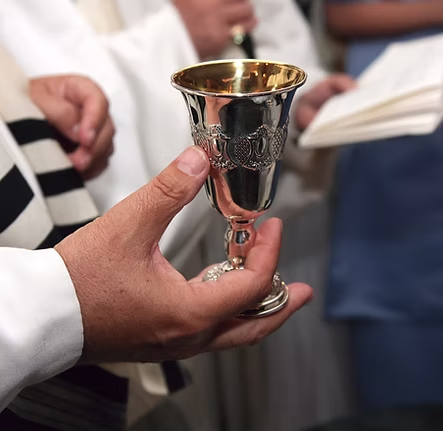
Finally, we say the kiddush and motzi (blessings over wine and bread).
Speeches (Dvar Torah)
Following the Torah service it is customary for speech to be given by the rabbi or another member of the congregation, often pertaining to the Torah portion that was just read.
As a bar mitzvah, Ari will share his learnings with the congregation. Additional speeches may be made.
Torah Reading and Haftarah
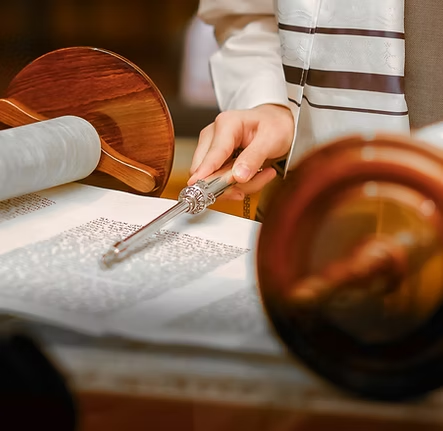
The Torah service has three components: procession of the Torah, reading of the Torah, and return of the Torah. It begins with the opening of the ark and one of the Torahs is removed. The Torah is carried through the sanctuary accompanied by prayers and singing.
Next, the weekly Torah portion or Parsha is read. The reading is determined each week according to the Jewish calendar and consists of eight parts. Each part may be read by a different person and is introduced by blessing recited in honor of reading the Torah called an aliyah (literally "to go/rise up"). When the eighth reading is completed, the Torah is lifted high in the air for all to see.
Ari will read the Torah for the 6th and 7th aliyah and Maftir.
Following the Torah reading, a selection from the book of Prophet or Haftarah is chanted. Ari will recite the Haftarah.
Before the Torah is returned to the ark, some prayers are said for the wellbeing of the community, the government, and Israel.
The Amidah (Standing Prayers)
The core of the service is a set of prayers that are recited standing (hence the name) and silently to oneself. When individuals have completed the prayers, they may sit down. The prayers are then repeated aloud by the leader. There are some responsive sections when the congregation joins in again with an "Amen."
The Shema and its Blessings
The Shema is one of the most central prayers in the Jewish service. It is actually comprised of several prayers, but the Shema itself is a six-word sentence followed by several paragraphs of text from the Hebrew Bible.
The morning service opens with the singing of Psalms. These are recited as a kind of "warmup" to the main service. Some are recited silently and some aloud.
Psalms and Hymns
The Service
In Jewish tradition, there are three services each day, the morning or Shacharit service, the afternoon or Mincha service, and the evening or Maariv service. Each service follows roughly the same structure, but varies somewhat. The morning service on Shabbat is distinguished by the reading of the Torah.
During a child's b'mitzvah, it is traditional for the child to lead the congregation in various parts of the prayer service including the chanting of the Torah and haftarah (a selection from the book of Prophets).
And now, we eat!